I have a lengthy and detailed interview up on Indie Hackers about the history and business behind my nutrition analysis software, cronometer.com:
TL;DR I potentially piss off a lot of my friends, family, and strangers because I tell them that I think their minds are infected with highly-evolved ancient self-replicating mind-viruses.

Some prominent Atheists such as Richard Dawkins and Bill Maher, endorse mockery of silly religious beliefs. While these beliefs are certainly deserving of mockery, and they have an absolute right to do so, I think it frames the problem poorly. Religion is a public health issue. It is an infectious disease. We don’t mock people with the Flu, HIV, Ebola, or Polio. We treat them — with quarantines, vaccines, and other therapies.
A biological virus is a small capsule of DNA (information) that infects a cell and hijacks it’s internal machinery to churn out trillions of copies of itself which can then be spread to other hosts. They self-perpetuate themselves and have evolved mechanisms to do so with extreme efficiency.
Religions are mental viruses. They attack their hosts minds, inserting their ideas. Successful religions are fine tuned with adaptations that have helped them survive and spread through human minds.
- They disable critical and skeptical thinking, and make a virtue of accepting things on blind faith.
- They are are aggressive towards other competing religions or belief systems.
- They have mechanisms to spread through preaching, missionaries, churches, and community social pressures.
- They provide satisfyingly easy answers to alleviate existential angst
None of these traits are an accident. The world’s religions have survived and evolved, in the darwinian survival of the fittest sense, over thousands of years. They are enormously successful at spreading — most of humanity is infected with some strain of the Religion Virus. Like biological viruses, there can be different strains of each type. Some types of flu are extremely deadly (Spanish Flu, Bird Flu), others more benign. Likewise, we have plenty of benign, peaceful Muslims in the world, but also radical extremist strains experiencing a huge surge. Christianity had a pretty destructive strain for a while as well (Crusades, Inquisition). There are other strains of mental viruses that aren’t quite religions, but are similar. Nationalism can be considered a weak strain, as can political ideologies and conspiracy theories.

They infect people with weak or undeveloped mental immune systems — In particular, children. As a child your brain is still learning how the world works and developing a framework for understanding it. All religions are full of whacky unsubstantiated crazy ideas from ancient texts. It’s hard to understand why anyone would believe such nonsense, unless authority figures have been telling you it’s true since childhood. This is clearly evident from the fact that most people share the religion of their parents, not as an inherited trait, but through childhood infection.
Due to the mental infection, their entire way of processing the world has been framed by these religious ideas, and it creates a stunning blind spot in the mind, which is well defended by adaptations such as blind faith and social pressure.

A religious mind has never had to deal with true, deep, existential dread. If you’ve spent your life ignoring these issues because your religion gave you a candy-coated heavenly afterlife, it can be too painful and overwhelming to accept anything else.
Adults, especially young adults suffering from heavy existential angst and/or a mental illness are also vulnerable to religious infections. This is how a lot of extremist terrorists are first radicalized. Desperate for meaning and purpose in life, martyrdom can offer them a quick answer. These viruses have evolved amazing mental tricks to spread and perpetuate. There are probably millions of people on the planet right now, who actually believe that I should be beheaded simply for writing this essay, and they even believe they will be rewarded with virgins in heaven for doing so.
RELIGION – Together we can find the cure
— Richard Dawkins
If one accepts the thesis that religions are a public health issue, then what is the solution? Richard Dawkins has gone as far to suggest that indoctrinating children in a religion (for example, telling children they’ll burn in hell for eternity, etc..) should be considered child abuse.
As mentioned earlier, It’s very difficult to remove religious infections from adult minds. It’s too deeply rooted at that point and has aggressive self-defense countermeasures. Clearly, preventing new infections in children could break the cycle. However, any effective means of doing this by force would tread on our deeply important freedoms.
The only reasonable solution I can see is deploying the equivalent of a childhood vaccine. We need to teach young children critical thinking skills so that their minds have some defence against infections. They may still grow up religious, but will likely carry a more moderate strain, and have a better chance of shedding the virus as an adult.
Science flies you to the moon. Religion flies you into buildings
— Victor J. Stenger
In this age of rocket-ships, nuclear weapons, genome sequencing, robots, self-driving cars you can talk to, It’s getting tiresome sharing the planet with people who are making major decisions — political, life & death decisions, based on ancient texts full of irrational self-replicating belief systems. The human race needs to evolve beyond this global mental maddness.
Posting this essay is very difficult for me. Many people I know and love — good friends and family — were infected with religious memes at a young age, through no fault of their own. Because of these beliefs, simply reading this may cause them pain or anger — their belief systems will aggressively fight these ideas and any cognitive dissonance it creates. Please know I still love & respect you, and this is not meant to be an attack. I’m just laying out the facts and how I see the world through the lens of my own belief system.
I’m 100% certain it won’t take long for the comments section below to become full to the brim with angry comments defending religion because, well, that’s part of their evolved defence strategy.
Amen.
I’m a bit of a bitcoin enthusiast. I run a small web business called CRON-O-Meter that lets you do detailed nutrition and fitness tracking. The free version is ad-supported, but users can upgrade to a premium ‘gold’ edition with no ads and premium features. In June, I added Bitcoin (using BitPay) as an additional way to purchase gold subscriptions, to the existing options of credit-card (using Stripe), and PayPal.
I even placed the bitcoin option above PayPal:

Serious kudos to BitPay, who’s API was super simple and easy to implement, test, and deploy in just a few hours. BitPay gives retailers the option of instantly converting some or all of received bitcoins instantly to USD. For the record, we’re keeping ours all in bitcoin, and hope someday we can pay some of our hosting expenses and contractors in bitcoin, rather than fiat.
So far, after 4 months, the results have been pretty underwhelming. Just 0.73% of our purchases have been made using bitcoin, and PayPal is still the dominant option our customers choose.
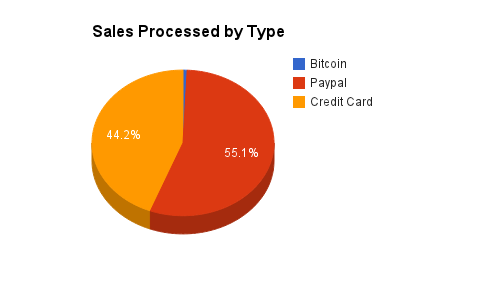
This shows how far bitcoin still has to go before one could consider it a mainstream payments choice. I’ll revisit this in an update post in another 6-months to a year and see if things have changed.

Here’s what I’ve been working on the past couple of months — Chatbox, a site that lets you form instant chat rooms with any group. You can even take an email thread and turn it into a chat room by cc’ing chat@chatbox.com. Participants get sent a link and are instantly in a persistent chat room. You can share files (just drag & drop anything into the chat).
It’s perfect for any sort of team project — you can drastically cut down on your emails by keeping a chatbox going. It’s also great for quickly getting a group together to decide something. Planning with your group where and when to meet for drinks after work? Instead of sending 400 emails back and forth, just launch a chatbox to hash it out in real time.
Anyhow, we’re in public beta now — please check it out. Try out it with your teams, clubs, groups, friends, and post your feedback.

Hot on the heels of our other two games, Jawfish Poker has just been released into the App Store. In this casual poker game, we’ve boiled poker down to it’s essence for quick action. Every hand is played heads-up from the pool of available players, and you can only go All-in or Fold. You only have a few seconds to act for each decision, so game play is super fast. You can play an entire tournament while waiting in the grocery line.
We also have a cash-game mode called King of the Hill, where players can come and go like in a cash game, but the player with the largest stack at the end of every minute of gameplay is the King of the Hill, and wins bonus coins from the jackpot pool. The blinds are dynamically set on each hand to be roughly 1/10th of the smaller of the two stacks, so every hand is a big decision. I hope you’ll check it out!



Just a follow up to my post on energy backed currencies. It looks like this idea is starting to get some attention, especially with bitcoin getting people thinking about alternative currencies. Here’s an interesting blog article about the Joule Standard.

Match-Up!
Just wanted to let y’all know about my new iOS game. Created by a startup I co-founded, Jawfish Games, and published by Big Fish Games, Match-Up! pits players into multi-player, real-time tournaments where players comete in casual games of skill. You can currently play Mahjong, Word Rack (a word scramble game), and Qbeez (a block clearing game).
I’m super exciting to finally have this game out for the world to play. We’re launching several other fun games in the coming months that will also feature real-time multiplayer tournaments on your mobile devices.
I’ve just combed my iTunes playlist for my most played and liked songs of 2011. Here are the winners of the prestigious 2011 Aaron’s Favorite Tracks Awards.
1) Opportunity by Brasstronaut, Album Opportunity EP
Just a kick ass track, amazing on so many levels. Funky and tight, with a depth of layering that rewards multiple listens. I’m very much looking forward to their upcoming album. Runner up would be Hollow Trees, from the same EP (free download), also a beautiful track.
2) Comedown by Ohgr, Album Undeveloped
Simple, catchy, with a great build towards the end. Me likey. Runner up track: Pissage.
3) Icktums by Skinny Puppy, Album handOver
Granted, Skinny Puppy is an acquired taste, but lets just say I have acquired this taste in spades. Thus, the infrequent treat of a new Skinny Puppy album is always a time of great glee. This track is my pick of the album, with all the madness and chaos Puppy does best. Runner track up is Village.
4) WDKYWMYK by Rabbit Junk , Album Lucid Summations Single
Unnnnngg. Two rocking songs in one really. The first bit, some dub-steppish bad-ass badassery that breaks into a Marylin Mansoneqsue rock anthem. Behold:
5) Please take your hand away by Trent Reznor and Atticus Ross, Album The Girl With the Dragon Tatoo Soundtrack
My chill out mellow pick of the year. Runner up Parallel Timeline with Alternate Outcome.
 This is a little late, but version 0.9.9 of CRON-o-Meter was released a few weeks ago.
This version brings an update to the foods database (USDA sr24). Naturally my web version of the popular nutrition software was also updated with this new data.
The website’s traffic has been steadily growing since it was launched in March.

For anyone that checked out the site several months ago, but didn’t switch over, I strongly suggest checking it out again, as there’s been a lot of work and improvements made over that time.
I’ve run the whole thing as a bootstrapped startup, and almost all of the growth has been organic (A negligible amount of traffic is from online paid advertising). A bootstrapped startup is one that starts with basically no capital investment, besides your own elbow grease. It starts generating income modestly from the start, and then feeds that back directly to cover operating expenses as it scales.
It’s currently making about 25% of its revenue from the mobile app sales (iPhone & Android), 25% from advertisements, and 50% from the gold subscription sales. There’s still a long way to go before I can claim a stable income, but the steady growth and revenue stream has been quite encouraging that all the hard work I’ve put in over the past 8 months will be worth while.
If anything, it’s been a tremendous learning experience, and at times frazzling, to mentally juggle so many codebases and platforms (the Java/GWT/SQL website, Android, iPhone, and the original open source version).
I’m surprised that the iPhone version is outselling the Android app nearly 4-to-1. I had thought there were a lot of Android users out there, but maybe they don’t like buying apps as much as iPhone users.